The audioguide that disappears
Reinventing the museum audioguide for a major Parisian art foundation's 2028 reopening. A two-week tender response led at Artefact, designed around a single concept: a mediation system that disappears as a device and persists as a presence. The work continues today.
Product Designer · Parisian art foundation · 2025 – now
Prototype · the core mechanism is testable inside this page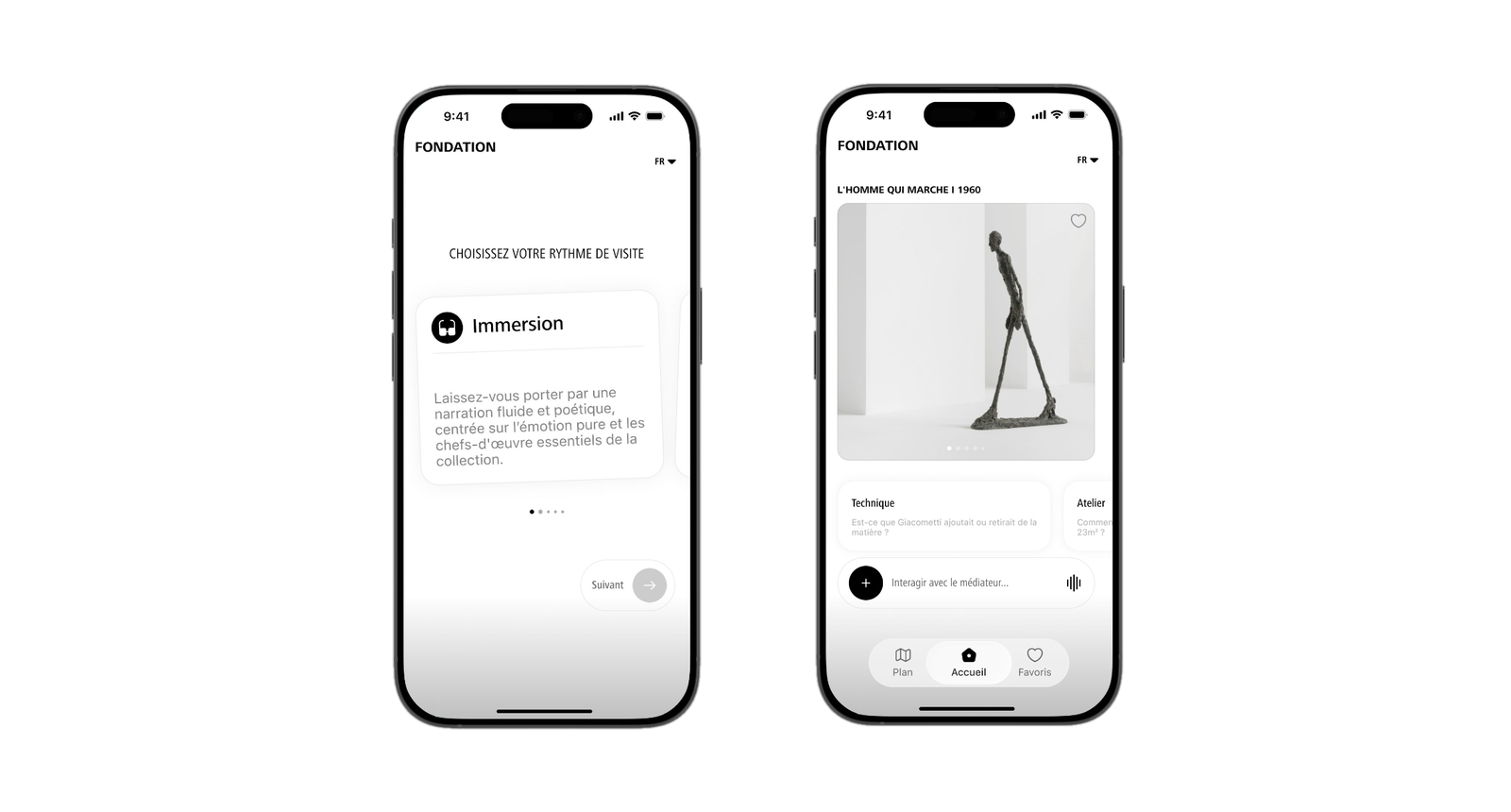
The brief, in one sentence
Reinvent the Fondation's audioguide to offer future visitors a unique encounter with Alberto Giacometti's universe, in time for the new venue's opening in 2028 and an expected scale of up to a million visitors a year.
The current Fondation is intimate, specialized, and confidential. The next chapter has to welcome a more diverse, more international, more first-time audience without losing the closeness to the work that defines the place today.
The mechanism, proven
A proposal is a promise. I wanted to know if the core of this one held up, so I built it, and embedded it here: the card below is not a mockup. It detects your approach, narrates at the rhythm you choose, and answers questions out loud, live in this page.
Personal prototype · try it
Searching for nearby works…
L'Homme qui marche I · Bronze [1960]
126 words · ≈ 48 s
Look at this silhouette. …
The page really watches you approach. A native browser API, IntersectionObserver, plays the role of the BLE beacon, with the same contract: presence wakes the screen, nothing else to do.
const beacon = new IntersectionObserver(
  (entries) => {
    if (entries.some((e) => e.intersectionRatio >= 0.4)) {
      // The visitor "approaches the work":
      // same contract as the BLE beacon, presence wakes the screen.
      setTimeout(() => setDetected(true), 500);
      beacon.disconnect();
    }
  },
  { threshold: 0.4 }
);
beacon.observe(rootRef.current);
The narration itself ships four workarounds for the browser's speech synthesis: Chrome goes silent when speak() follows cancel(), cuts long utterances around fifteen seconds, keeps a stuck paused state across navigations, and drops garbage-collected utterances mid-sentence. Each one has a fix in this page, and each one is invisible when it works. Which is the point.
And because the mediator's field is a public LLM endpoint, every question walks through production guardrails before it reaches the model:
Unknown origin
403, refused
More than 5 questions / minute / IP
429, slowed down
Empty or over 300 characters
400, rejected
Valid question
Claude, museum-scoped prompt, ≈ 80 words max
No key, outage, timeout
Scripted fallback: the card answers anyway
No dependency added: IntersectionObserver, speechSynthesis, and the React and Framer Motion the site already had.
prefers-reduced-motion respected: the equalizer holds still.
Keyboard and screen readers: aria-pressed on every control, subtitles synced to the voice.
Bilingual content fact-checked against the Fondation's sources; two claims corrected.

Try it hands-free
Scan with your phone: it becomes the audioguide (rhythm, works, narration) while this page stays the story. The same gesture as the product's QR enrolment.
BLE beacons in the room
Detection as the page scrolls
Bone-conduction headphones
The browser's speech synthesis
AI-generated narration
Hand-written texts, one tone per rhythm
Open dialogue with the mediator
A language model online, scripted answers as fallback
Prototyping is deciding what to build, what to simulate, and what to postpone. This prototype is my personal research on the subject: it does not involve the foundation in any way, and does not prefigure the final product.
This prototype was specced, built, and fact-checked solo, with AI as the team. It is the working demonstration of two essays published here: The one-person product team and The spec is the new wireframe.
What the audioguide doesn't do today
With the team, I ran field studies in several museums, from large Parisian institutions to regional ones, so we could cover several types of visits. Different audioguide ecosystems, different failure modes: ergonomic friction, technical brittleness, audio quality that isolates the visitor from the room.
On paper, audioguides do well: 85% of museum visitors report being satisfied. The friction hides in the drop-offs: 59% of non-users cite price, 43% the fear of being socially isolated from their group, 34% the loss of free movement.
The lesson: redesigning the audioguide is not a content problem. It's the medium itself that needs to disappear.
Figures: museum audioguides in the post-Covid era, university thesis, Lyon 2 University, 2024.
The concept
From the field study, the literature review, and two weeks of tender work, three convictions converged. They shaped every design decision that followed.
Narrative essence
Move from delivering facts to telling stories, true to Giacometti's universe.
Inclusive personalization
AI that adapts to the language, rhythm, and sensibility of every visitor.
End-to-end experience
A seamless arc that unites digital and tangible, from before the visit to after.
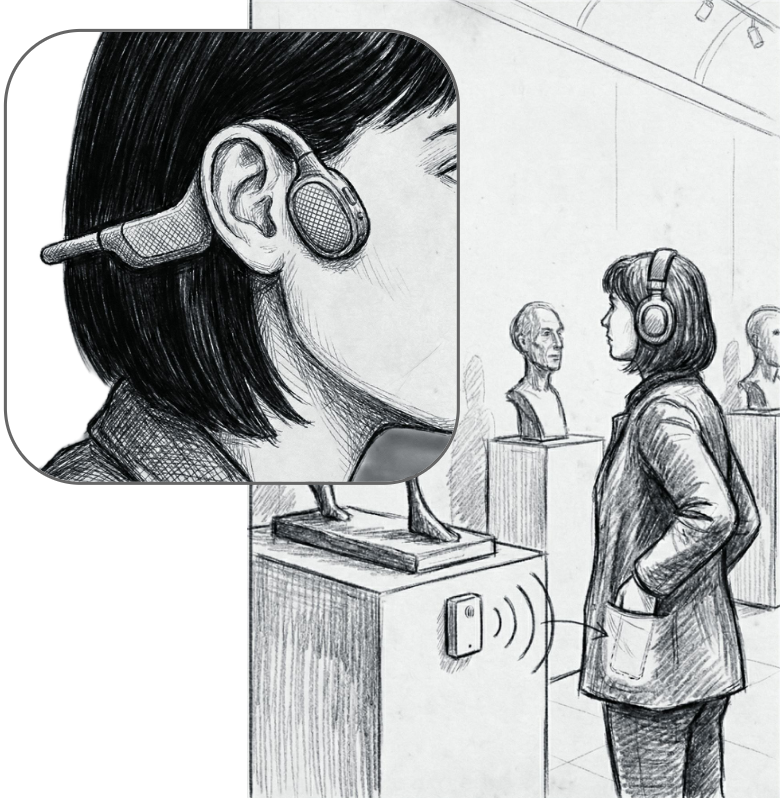
A mediation system that disappears as a device and persists as a presence. The visitor never holds a device, never taps through a menu in front of a sculpture. Bone-conduction headphones, Bluetooth beacons placed near works, and a conversational AI compose a system where the technology does the work without showing up.
Three principles hold it together: deep personalization at the entry, beacon-driven immersion in the rooms, and hybrid engagement on demand through a dialogue with the AI.
The proposal went beyond the screen: a research track imagined sensory totems, sound, touch, scent, placed at key points of the visit. The track stayed at concept stage, but it said the essential: in 2028, technology should not look at you. It should resonate with you.
Before the room
The experience brackets the visit on both sides: two of its four phases happen outside the museum entirely. That extension was the brief's most stretching requirement, and the part I spent the most time defending.
Before
Enrolment
App Clip or QR scan: instant access, no install.
In the museum
Profiling
A declared intent, a narration calibrated by AI.
Immersion
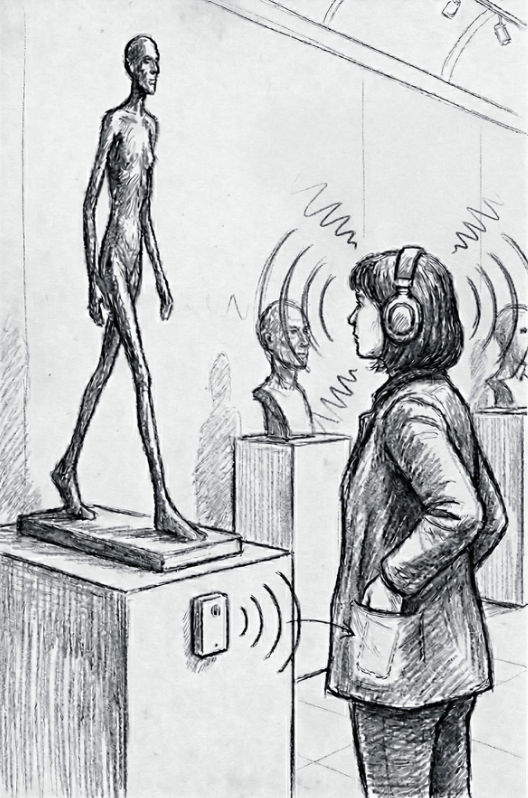
The beacon triggers the narration. Hands free, no screen.
Continuity
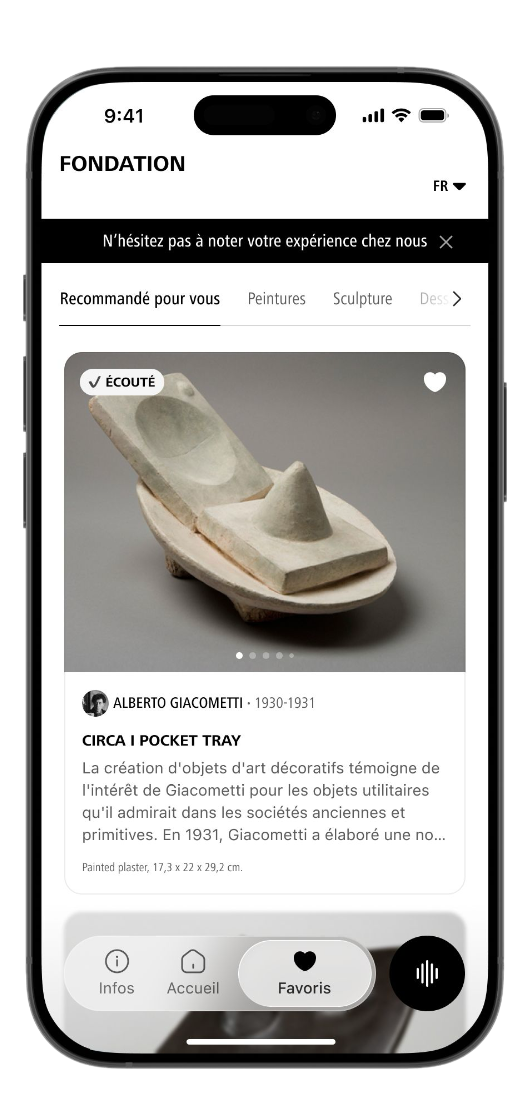
A souvenir collection extends the visit back home.
After
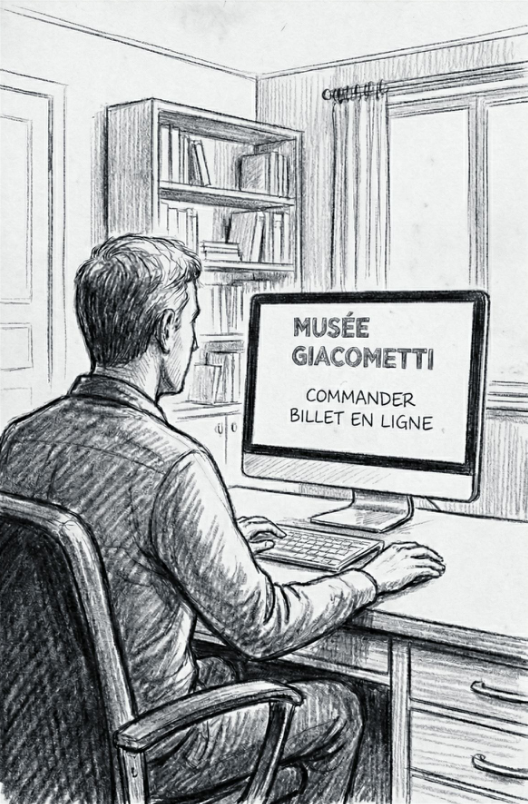
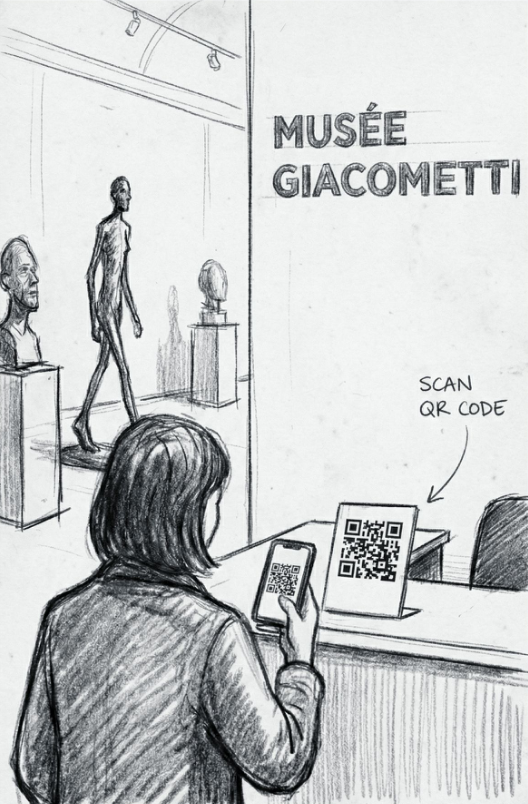
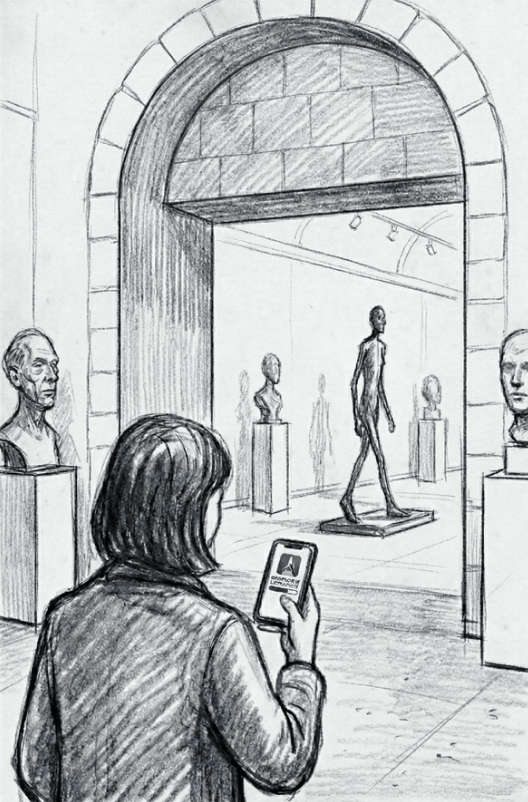
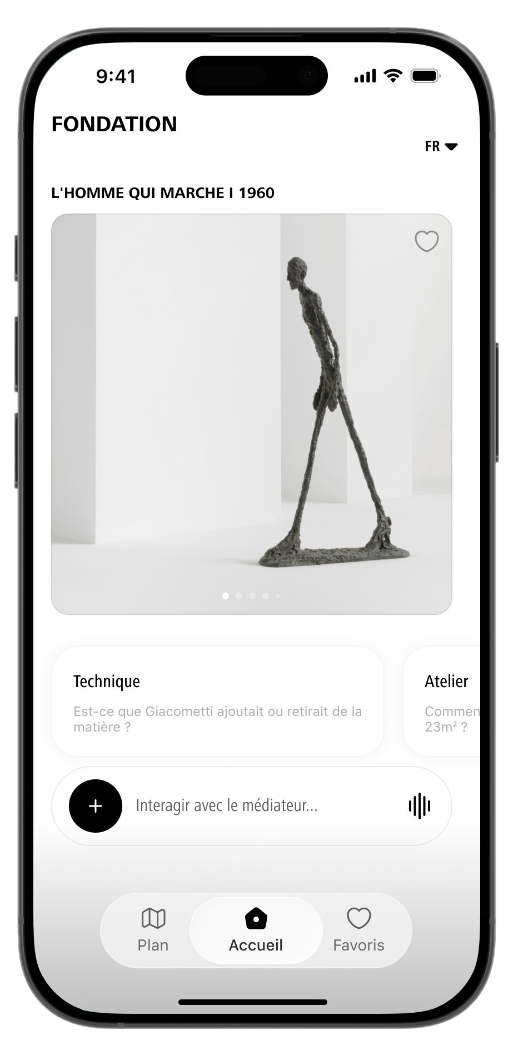
The visitor books online at home or scans a QR on arrival. The app launches via App Clip, no install screen, no friction. A short tutorial introduces the bone-conduction headphones and pairs them in seconds. The aim of this phase is invisibility: by the time the visitor faces a first sculpture, the technology has receded.
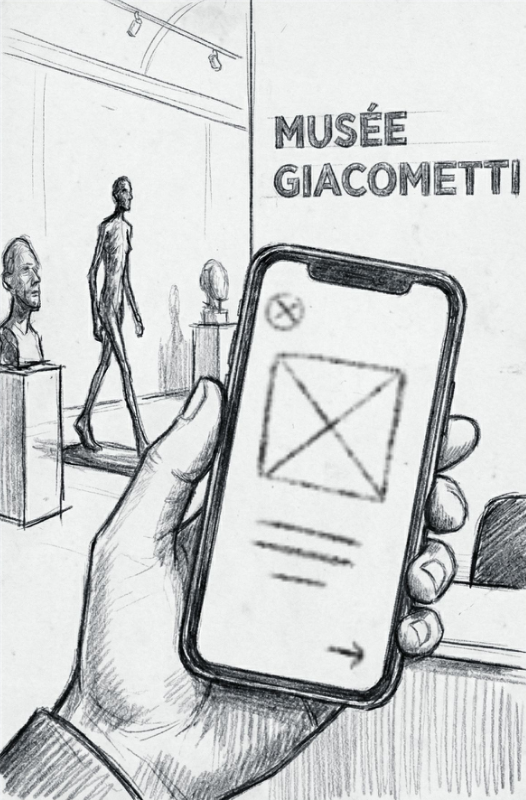
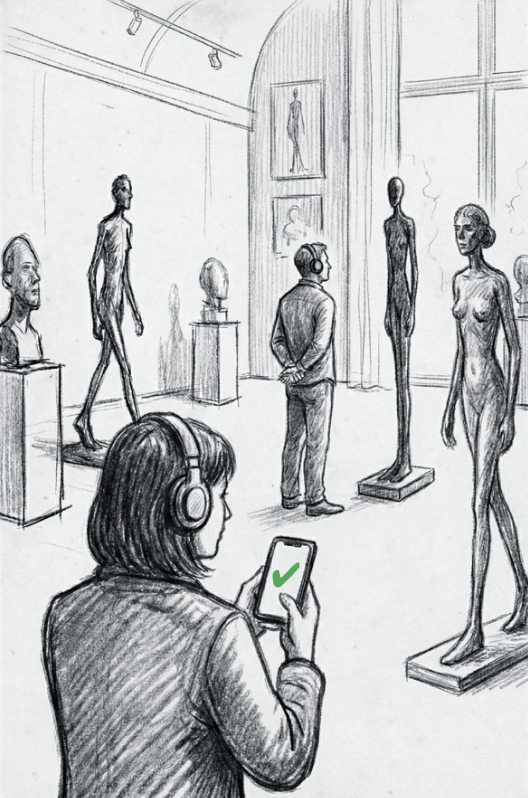
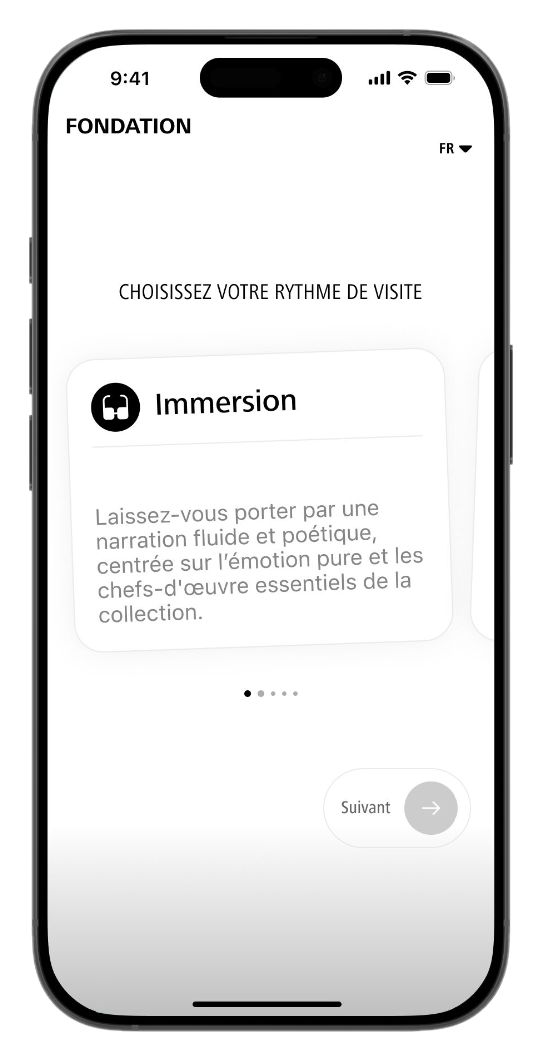
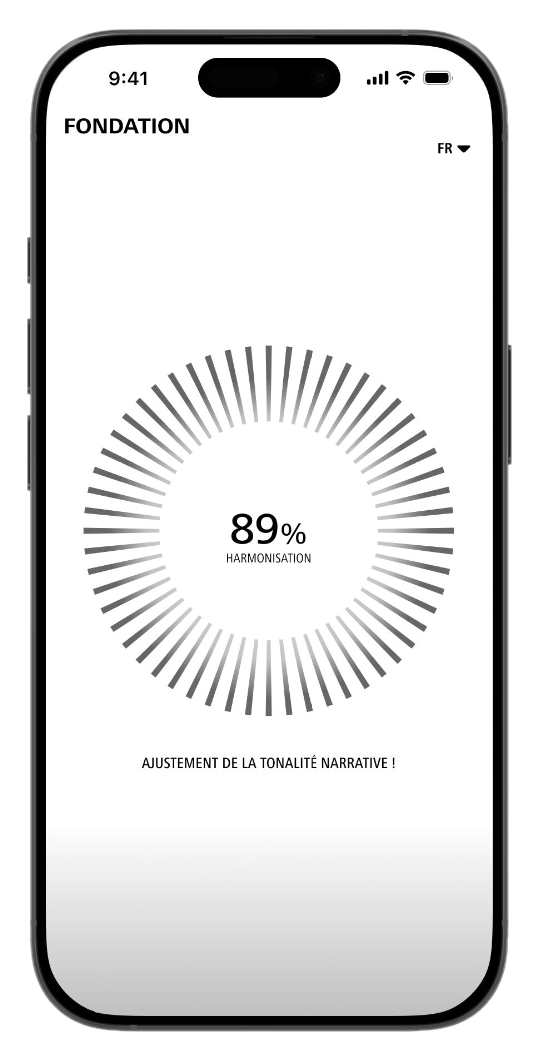
Instead of asking the visitor to label themselves ("adult", "child", "expert"), the app asks them to declare an intent: a rhythm and a posture. Language preferences and accessibility settings are absorbed here too. The AI calibrates tone and density of the narration against this intent, in real time, and confirms the harmonization quietly.
In the room, and after
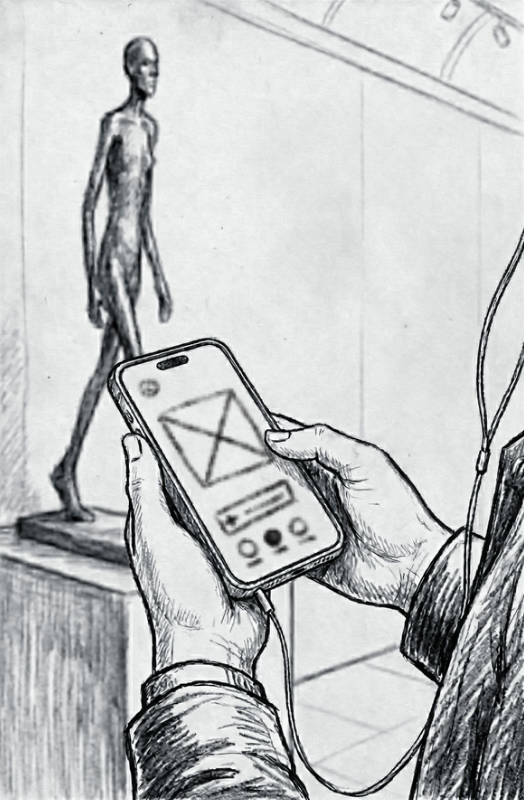
Bone-conduction headphones leave the ears open to the room. Beacons placed near each work trigger the right narration as the visitor approaches. No menu to navigate, no QR to point at. If the visitor wants to go deeper, they can question the AI by voice or by text. Otherwise, the screen stays in the pocket and the work stays in the foreground.
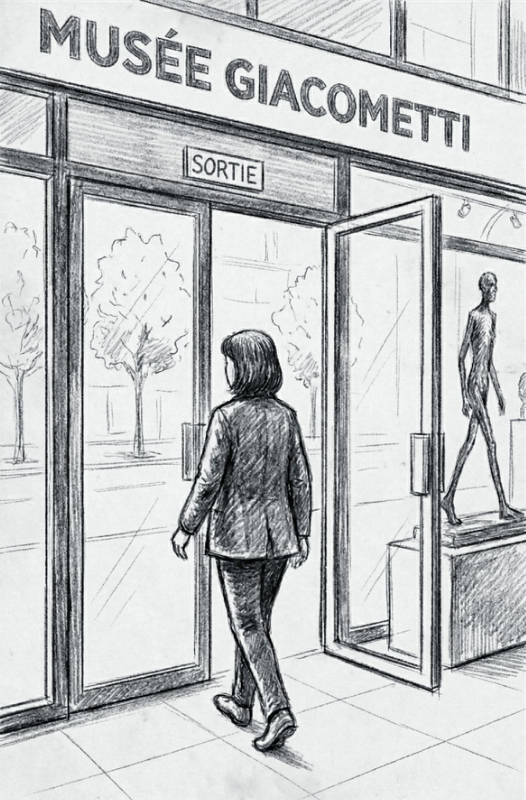
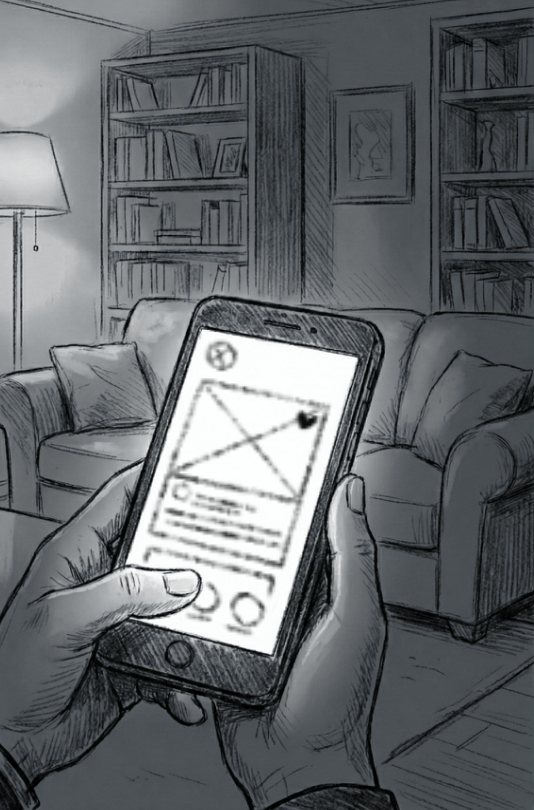
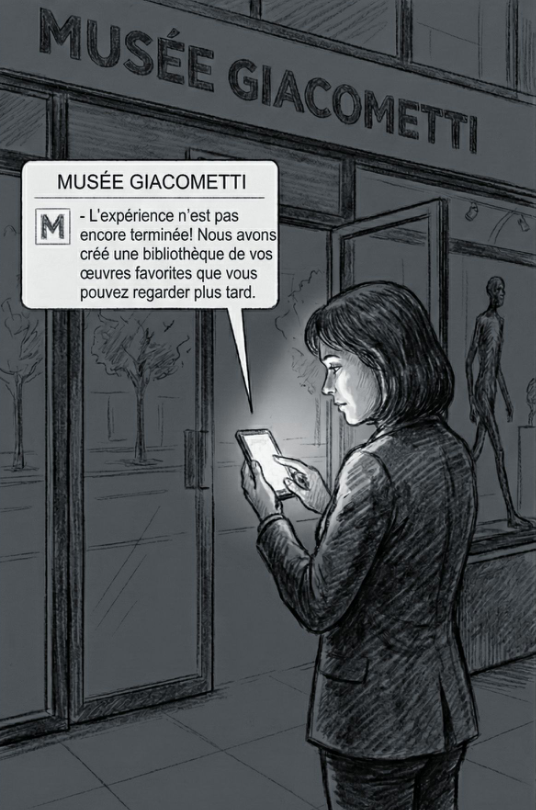
The visit doesn't end at the door. A short notification invites the visitor to come back to a souvenir collection built from the works they paused on the longest. The collection isn't a marketing object, it's a way to extend the encounter quietly, at home, in the days that follow.
What this proposal taught me
The hardest part was not the interface. It was earning the right to remove the interface entirely. A cultural institution rooted in the privacy of an atelier does not naturally accept that the answer to scale is to be quieter, not louder.
On a personal level, this project pushed me to think of mediation as architecture rather than a feature set. Every interaction either disappears into the work or competes with it. That binary shaped the convictions, the journey, and the totem alike.
Next project
Evaneos