Yippee
What if screen time could make children smarter, not quieter? Yippee is a side project I designed and shipped end to end, an AI plush toy companion that listens, adapts, and grows with each child. Prompt architecture, mobile app POC, Flask backend, voice tuning: all of it built solo.
Solo · design, research, engineering · React Native · Flask · GPT-4o · ElevenLabs · Beta with 8 families · 2024 – 2025
8 families
14 children · 3-week test
11 / 12
preferred Yippee in voice A/B
4.2 min
median session
~1.4s
voice in → voice out
The product
Kids aged 4-7 spend nearly 5 hours daily on screens. Language disorders rose 94% in a decade. The market is full of content apps. Nobody was building a companion that actually talks back.
The intuition came from a small frustration (my niece sitting through 40 minutes of passive YouTube, her parents guilty but with no alternative), but to check whether I was reading the gap right, I went looking. I handed out flyers at local schools to find families willing to test a prototype. I spent weeks in parent forums where the same anxieties came up again and again: too much passive content, too few alternatives, no time for proper supervision. The 300+ parent survey came out of those conversations.
Yippee's real form is a plush toy. Something a child can hold, carry, and talk to. It listens, adapts, and grows with them. It explains the world in words a 5-year-old understands, follows their curiosity wherever it goes, and checks in on their emotions along the way. The mobile app is the POC, a way to prove the conversation, the personality, and the safety logic before molding silicone and sourcing speakers. The plush is what the project is for.
The educational toy market is growing from €58.9B to €98.9B by 2034. The 300+ parent survey confirmed the gap: 77.4% want tools that develop curiosity, 48.4% want emotional support, and 74.2% would pay €20-40 for a smart toy that delivers both. Competitors focus on content (YoTo, Buddy.ai) or emotion (Lovot, Miko). Nobody combines both in something affordable.
How it works
Real-time voice conversation with a child, natural, safe, emotionally aware. Five services chained in a single request cycle, averaging 1.4 seconds end-to-end.
Child
Voice input
React Native
Expo · Audio capture
Flask API
Render · /ask endpoint
GPT-4o-mini
Prompt + context + safety
ElevenLabs
Multilingual v2 · Voice synthesis
Child
Hears the response · ~1.4s
The personality is built through layered prompts, not hard-coded rules. Safety wraps everything (a child can say anything). Personality defines tone. Personalization makes it feel like their companion. A rule system would break when a child mixes languages, expresses sadness mid-topic, or asks "why" 8 times in a row. The prompt adapts.
Safety layer
No harmful content · Age-appropriate language · Emotional boundary detection
Personality
Name: Yippee · Warm, encouraging, playful · Simple words, short sentences
Personalization
Child's first name · Conversation memory (3-5 exchanges) · Emotional state
Emotional check-ins
Every 3 messages · "How are you feeling?" · Adapts tone (calmer if sad, excited if happy)
Outer = highest priority · Inner = dynamic per session
Voice was the hardest part. Children are extremely sensitive, a robotic TTS breaks trust immediately. I tuned ElevenLabs with low stability (0.4) for natural variation and high similarity boost (0.8) for consistent personality. During an A/B test with 12 children, 11 preferred the less consistent voice. Every parent in the test said the other one "sounded like a robot." Day-2 retention climbed sharply after that single change. Small sample, but a clear pattern.
Prototype · try it
Ask Yippee
The product's real voice, tuned as told above: stability 0.4, similarity 0.8.
After that, every product call followed the same loop: pose a hypothesis, ship the change, watch how it landed in the next beta session. Bedtime mode lengthened sessions. The proactive emotional check-in cut session abandonment. The 8-family sample isn't proof, but the patterns were directional.
Child safety
A child can say anything, that's the hardest constraint. I ran 6 workshops mapping 8 categories of sensitive input (distress, trauma, manipulation, privacy, premature questions...) and defining response protocols for each, aligned with UNICEF's Safer Chatbots guidelines.
Every edge case was tested in prompt ping-pong sessions, real phrases a child might say ("mom hits me", "I'm worthless", "how are babies made") run against the system. The rule: never panic, never judge, always redirect to a trusted human.
Interface
The AI companion IS the interface. No menus, no navigation, no cognitive load. The child talks, Yippee responds. Parents get a separate dashboard for tracking learning and emotional patterns.
Visual identity
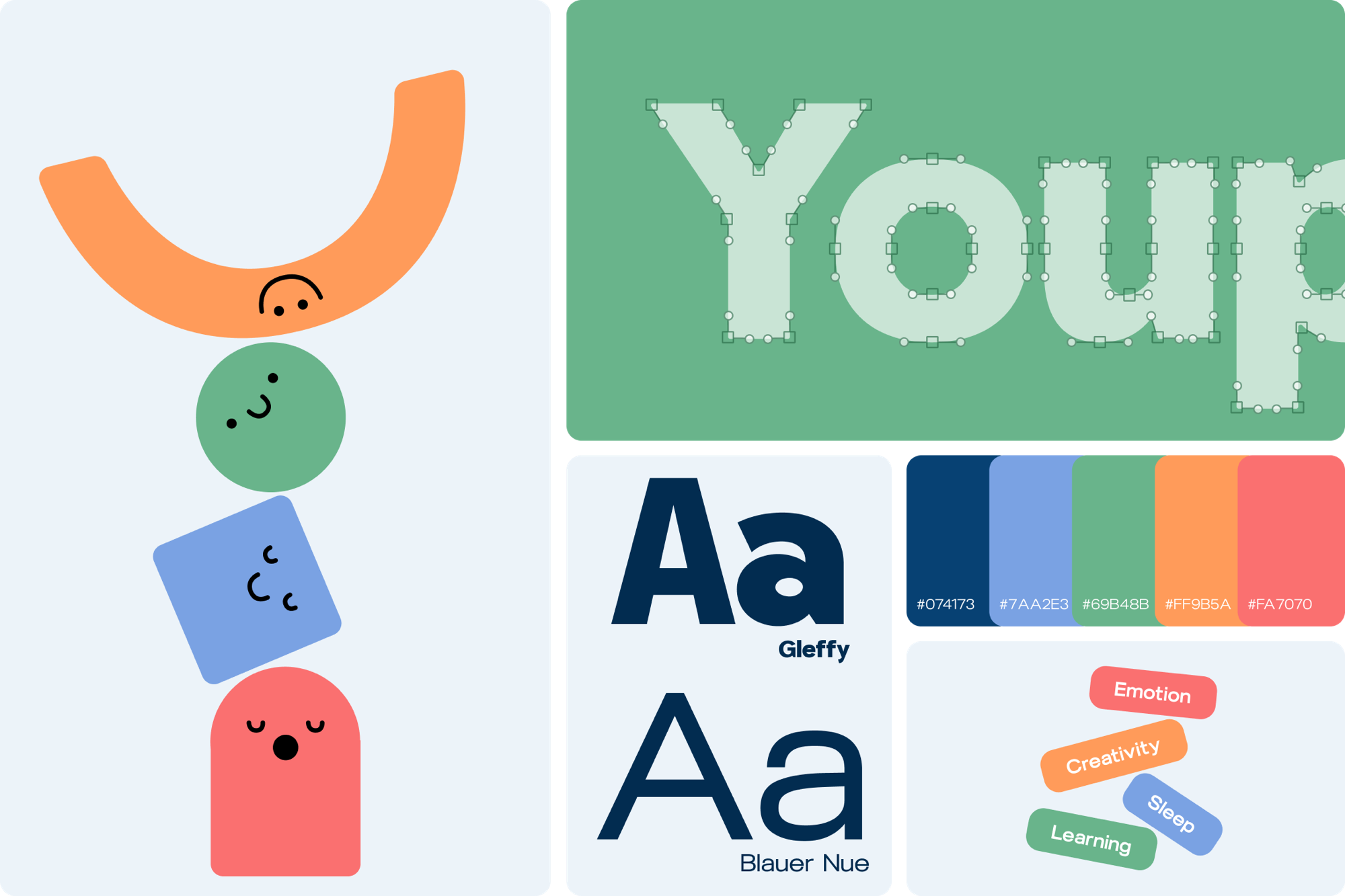
The brand had to read as a friend before it read as a product. Soft geometric shapes, no sharp edges, four mascot states that mirror the emotions Yippee listens for: curious, calm, playful, sleepy. The wordmark, drawn in a custom display face called Gleffy, keeps the smile of the mascots in its curves.
The palette is anchored on a deep navy that holds everything together, with four accents tied to the product's four pillars: emotion, creativity, sleep, learning. Body type is Blauer Nue, geometric, generous, very legible at small sizes on a parent's phone.
Parent dashboard
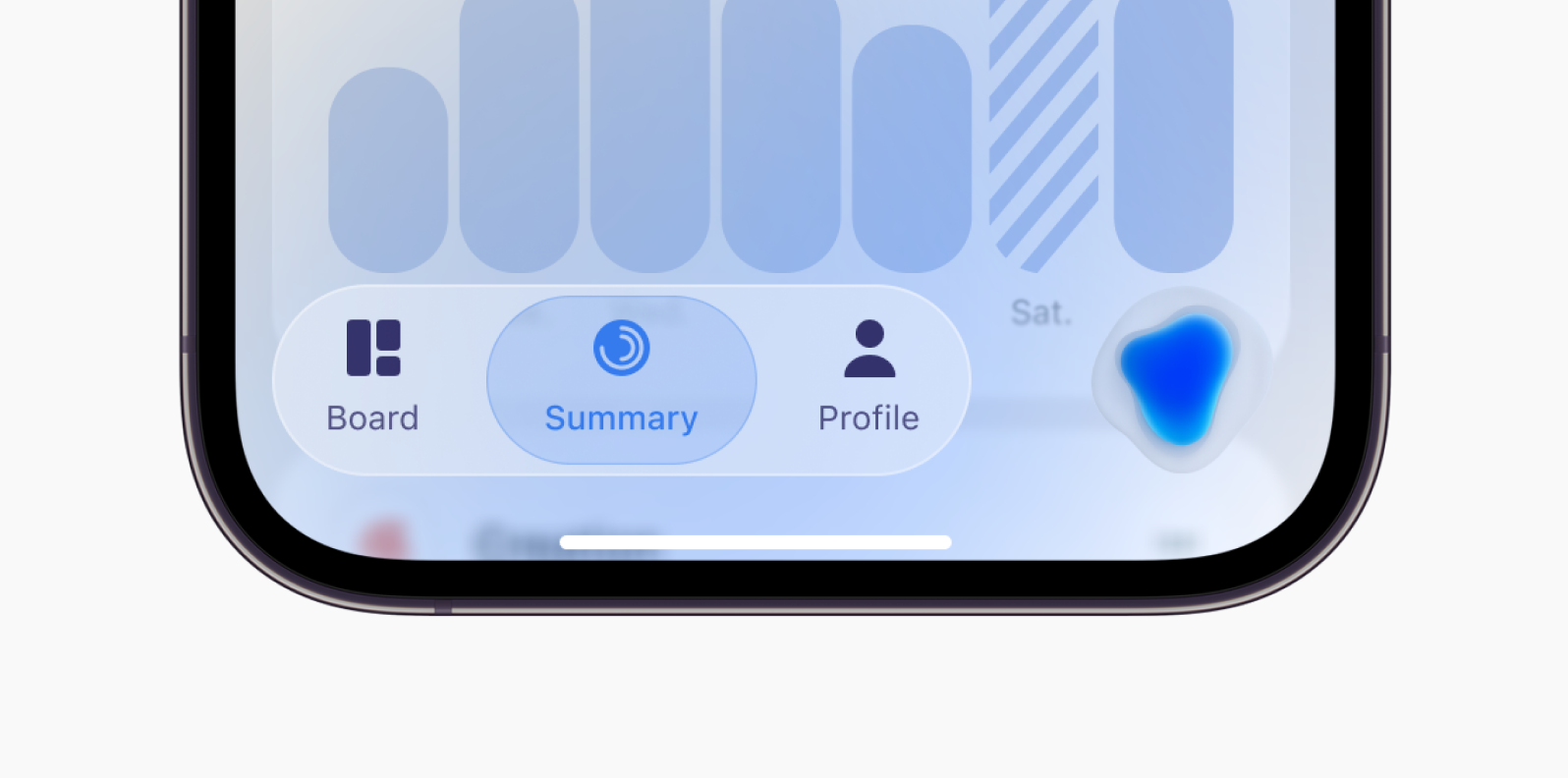
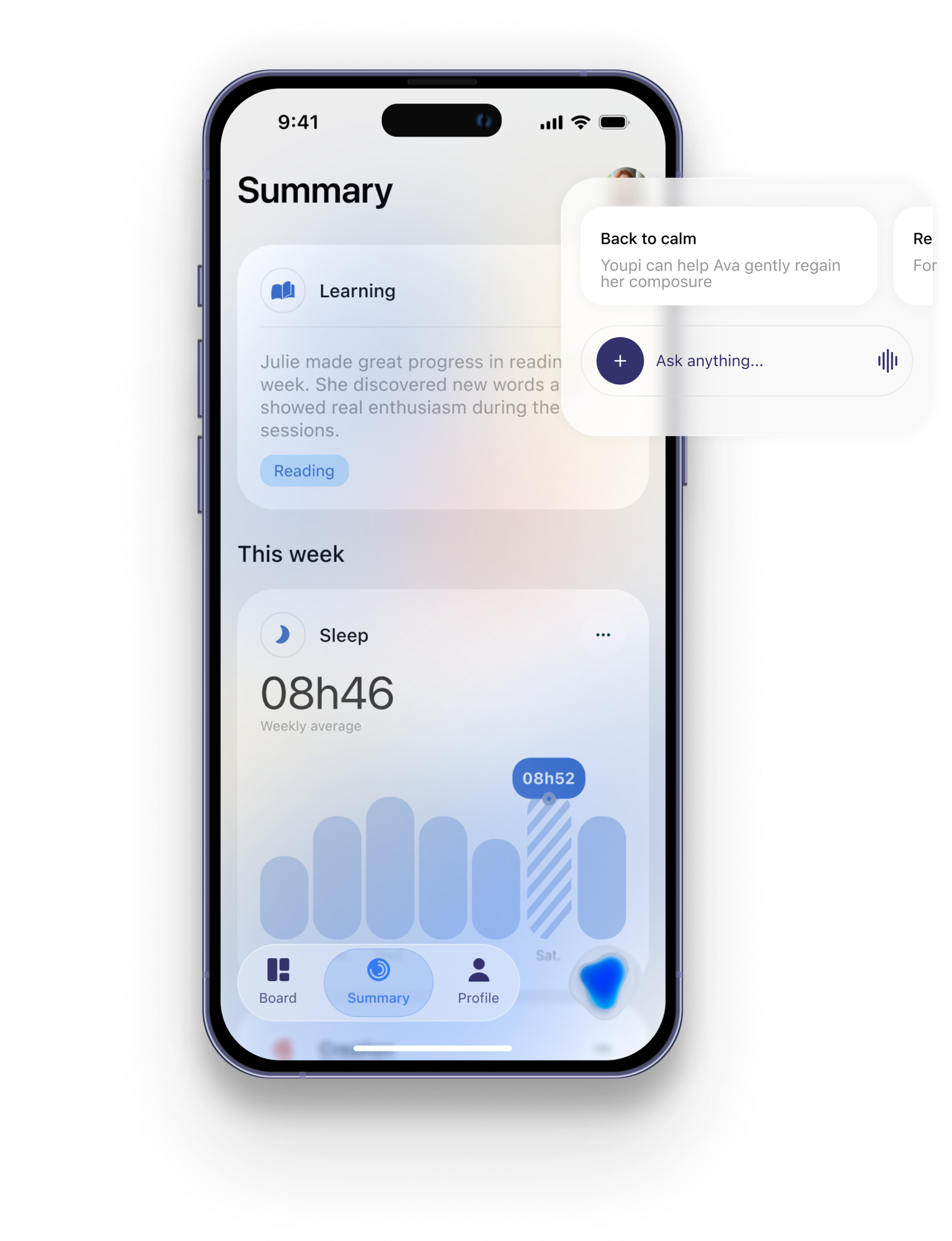
Parents get their own surface, a calm Summary screen that tells them what their child did this week in plain language. No raw numbers, no dense tables. The AI writes a short paragraph in the brand's voice, then surfaces one or two quiet metrics: pages read, average sleep, time spent on creative play.
A floating prompt sits at the bottom, Ask anything…, letting the parent dialogue with Yippee about their child without ever leaving the surface. Notifications like "Back to calm, Yippee can help Ava gently regain her composure" arrive in the same warm tone the child hears from the toy.
Where it's going
Yippee is intentionally a side project, I keep it private, I keep it small, I iterate on my own time. The prototype is grounded in real research: 300+ parent survey responses, 10+ family interviews, a structured safety framework, and a beta with 8 families I've been running on weekends.
Phase 1: Beta widening
Expand the beta to 20 families. More age ranges, more languages, more edge cases.
Phase 2: Hardware exploration
From app to interactive plush. Same AI, tangible form factor.
Phase 3: Safety open source
Open the safety layer and prompt architecture so other builders can reuse them.
Phase 4: Decide
Either ship a polished public app, or fold the learnings into the next side project.
What it changed for me
Yippee is the side project that pulled me into engineering for real. I designed the product, shipped the backend and AI pipeline, tuned the voice, ran 6 safety workshops, led research with 8 families, and deployed to production. No handoff, no PM, no spec sheet, just decisions, prompts, and the next day's data.
Shipping a full backend with AI, debugging it at 2am, tuning voice parameters until retention jumped: that's when designing a product and building it stopped feeling like two separate jobs to me. It pushed me deeper into the technical side, and I've worked that way ever since.
Next project
Tinkle